
| Volhynia home |
Volhynian German research ideas
Photo: A Zhitomir street scene
Running out of ideas on Germans from Russia research? Maybe one of these will help. This list is based on talks Dave has given to a variety of societies in Canada and the United States since 1998.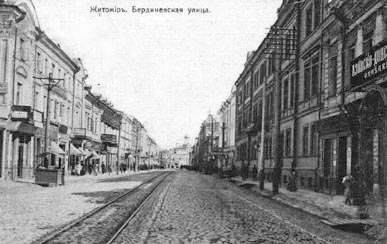 1. Relatives
The standard starting point for genealogical research. Ask your immediate family, as well as cousins and second cousins. Don’t forget the recent arrivals from Kasachstan who have arrived in Germany since the collapse of Communism. 2. Former residents of your ancestral village Your relatives might not remember, but others might surprise you with the amount they know about your family. Again, try the recent arrivals from Kasachstan. 3. Captured German documents The single most important resource for Volhynian researchers, and helpful for those working on any area. The collection is on microfilm at the National Archives in College Park, Maryland, but the films can be purchased by researchers anywhere. The collection includes copies of the forms filled out by refugees from the Soviet Union when they arrived on German soil during the Second World War. These people were required to give details of their ancestry, to prove they were not Jewish, Polish, or whatever. As despicable as that process was, it has given family historians a few breaks today. Along with ancestral information, the refugees were required to say where they lived, from birth to the date they filled out the form. They gave details about their families. If they already had relatives in Germany, they gave names and addresses. Many files include life stories, written by the refugees themselves. You can also find photographs. These films are available for about $65 US. Why are these films so valuable to Volhynians? The area was settled by Germans later than other parts of Russia. These forms will therefore provide the links back to Germany or Poland for many. More information on the Captured German documents is on the Einwandererzentralstelle page on this site. 4. The St. Petersburg Lutheran records They cover to 1885, and are available through the Mormon library. A massive indexing project is underway, and can be found on the Odessa web site. Transcripts from 1885-1920 have been found in the St. Petersburg city archives, but there are no plans to film them in the near future. 5. Deutsches Ausland Institut Information collected on Germans living outside Germany. Includes an index by village. The microfilms are at Salt Lake City. 6. Deportation lists From the Volhynian Guerian News; these lists identify German landowners in 1915. Several researchers have sets, as does the AHSGR. 7. U.S. passenger lists Lots of choose from, many of them indexed, and covering arrivals up to the Second World War. You’ll find them in the Family History Library Catalog. The Ellis Island web site has an index to arrivals at New York 1892-1924. Also check Ancestry for more comprehensive records. 8. Canadian passenger lists Not as many as in the U.S., and most are not indexed. There is, however, an online index to the lists from 1925-1935. It's on the National Archives of Canada web site. 9. U.S. naturalization records Many of these are also at Salt Lake, although many more are still held in regional archives. If you’re lucky, you’ll find an index. There are a couple of good guides to accessing U.S. naturalization records. 10. Canadian naturalization records The federal government still holds these, from 1918 to 1946. Indexes are found in the Canada Gazette and the report of the Secretary of State (included in the Sessional Papers). A guide to the published index has been published. 11. Border crossing records Between the United States and Canada. These can give valuable clues to origins, destinations and the like. They are available for people going either way. 12. Social Security Death Index On the Internet (try Rootsweb) and on CD-ROM. Covers most deaths in the United States from 1962 to the present. 13. California death index On microfiche at Mormon libraries, and on the Rootsweb site. Covers more years than the SSDI. (California is just an example; other states are available too.) 14. British Columbia death index It’s on the Internet as part of the provincial archives site. It covers deaths to 1985. The registrations themselves can contain good information. 15. Holland America records On microfiche at Salt Lake City. These records contain passenger lists for one of the lines that brought many Germans from Russia. 16. Canadian Second World War registrations All Canadian residents were required to register. For $45.00 plus tax, you can get a copy of a registration. 17. The Internet There are links elsewhere on this site to take you to the others. One essential site is SGGEE -- the only society devoted to Volhynian research. 18. Mailing lists E-mail from all sorts of researchers. Anyone can join these lists. 19. Wills and probate records These give valuable information on relatives. 20. Local church records The church your ancestors attended in North America might have information on where they came from. Check for the points of origin for the other arrivals from Russia - people often moved in groups. 21. Newspapers. Look for things such as obituaries, marriages and passenger ship arrivals. 22. On-line telephone directories These will help you find people quickly. They’re also on CD-ROM. 23. Der Sendbote obituaries Valuable sources if your ancestors were members of the German Baptist church. The AHSGR has a fine collection of these obituaries. Check the AHSGR's SOAR site for an index. 24. AHSGR member files One more way to make contact with distant relatives. 25. Bundesarchiv in Koblenz, Germany A lot of good material, if you can convince the staff that you need it. Mainly for Polish Volhynia. Includes the records of villages in Western Volhynia this are featured on this site. 26. Deutsches Zentralstelle für Genealogie In Leipzig. The Mormons have already filmed most of the good stuff. If you can’t read the Salt Lake films, though, you’ll be pleased to note that the Leipzig ones are much clearer. 27. Archives in Russia Take money, patience, and someone who speaks the language. Good luck. In Zhitomir, look for the seven boxes of file cards to do with Germans. Insist on seeing them all, even when the staff denies they exist. 28. Researchers in Russia There are good ones; check the Jewish genealogy web site for a current list. It’s better than actually going there yourself. 29. Salvation Army thrift shops Sometimes, you’ll find good stuff in their book section. Besides, it’s for a good cause. 30. Index to German war memorials. It's on the Web. A great source to confirm place and date of death for our relatives who joined the German army. 31. Luck When all else fails. |